The 8 GB Lab Book · Chapter 17
Embeddings as the cheap semantic layer
- Board
- Jetson Orin Nano Super
- Mode
- 15W
- Summary
- ViT-B/32 embeddings ran at 68 fps in 500 MB. At the best threshold, one accepted answer in three was wrong.
What I expected
ViT-B/32 sees 50 tokens where B/16 saw 197, so it has approximately a quarter of the flops. That was Prior 1. The TensorRTNVIDIA's inference compiler and runtime, which turns a trained network into an execution plan tuned for one specific GPU. B/16 of Chapter 15 ran at 3.5 TFLOP/s. At that rate this model takes 2.5 ms, which is 400 fps. I expected a torch FP1616-bit floating point (half precision): half the bytes of FP32, and tensor cores run it at much higher throughput than FP32. number near 5 ms.
Prior 2 was that the memory is near the weights plus a context. The weights are 88 M params x 2 B = 176 MB (nameplate). I used 400 MB as the estimate.
Prior 3 was that the 50 out-of-set frames would be much lower in cosine than the in-set frames. Some tau would separate them clearly, with precision near 0.9 while recall stays near 0.9.
The theory
Flops of B/32, derived; then P and R as counts
MACs, ViT-B/32 AT 224 (derived)
224 / 32 = 7: 49 patches + cls = 50 tokens
linears: 12 x 50 x 768^2 x 12 layers = 4.25 G
attention: 2 x 50^2 x 768 x 12 = 0.05 G
4.3 GMAC = 8.6 GFLOP per frame
= 8.6 GFLOP / 14.7 ms = 0.59 TFLOP/s
P and r are counts (arithmetic)
at tau 0.500: P 0.500, R 1.000
everything accepted, half correct:
  so 50 in-set queries, 50 out-of-set
TP = 50 x R; accepted = TP / P
false accepts = accepted - TP
= recall moves in steps of 1/50 = 0.02
The result is 0.59 TFLOP/s against the 3.5 of Chapter 15 on the same tensor cores, six times less. The model has a quarter of the flops and takes 1.5x the time of the B/16 TensorRT engineThe compiled, GPU-specific plan TensorRT produces from a network; it has to be rebuilt for a different GPU or TensorRT version.. This looks like the eager overhead of Chapter 13, now on a vision model. 12 layers x approximately 15 kernels = 180 launches (est.), and 14.7 ms / 180 = 80 us each.
The 68 FPS, placed (measured, then arithmetic)
- per frame
- 14.7 ms
- at 3.5 TF/s
- 2.5 ms
- of a 30 fps period
- 44%
- with Day 16's P3
- 58%
The setup
python3 ~/day17_embed.py
cat ~/day17/results.json | head -40"script": "day17_embed"
"note": "CIFAR10 classes are stand-ins for campus classes; no campus dataset available."
"model": { "arch": "ViT-B-32", "pretrained": "laion2b_s34b_b79k", "device": "cuda", "dtype": ...
"gallery": { "gallery_per_class": 20, "centroid_from_first_n_gallery": 10 }
"tau_sweep": [ ... ]
"best_tau": { "tau": 0.68, "precision": 0.648, "recall": 0.92, "f1": 0.76 }
"fps_bench": { "input_res": 224, "batch": 1, "frames": 200, "median_latency_ms": 14.723 }
"memory": { "tegrastats_ram_before_mb": 1637, "tegrastats_ram_after_mb": 2137, "tegrastats_ra...The measurement
| What | Expected | Measured | Note |
|---|---|---|---|
| best tau: P / R / F1 | - | 0.680: 0.65 / 0.92 / 0.76 | 5 CIFAR classes as stand-ins |
| embedding fps / ms | - | 68 / 14.7 | ViT-B/32 fp16, batch 1 |
| MB (tegrastats delta / torch peak) | - | 500 / 309 |
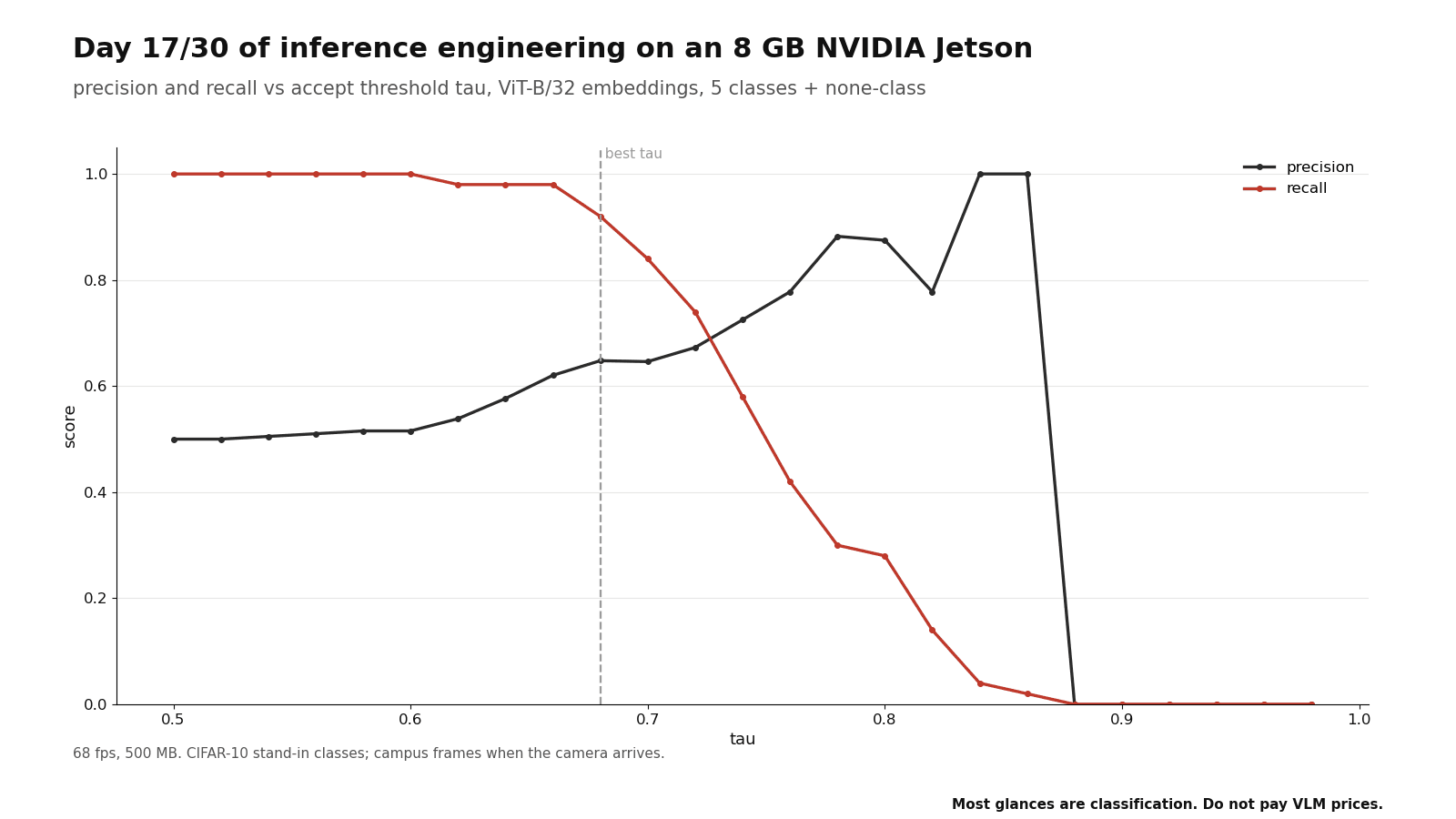
The tau sweep, in counts
| tau | P | R | TP | accepted | wrong accepts |
|---|---|---|---|---|---|
| 0.500 | 0.500 | 1.000 | 50 | 100 | 50 |
| 0.600 | 0.515 | 1.000 | 50 | 97 | 47 |
| 0.660 | 0.620 | 0.980 | 49 | 79 | 30 |
| 0.680 | 0.648 | 0.920 | 46 | 71 | 25 |
| 0.700 | 0.646 | 0.840 | 42 | 65 | 23 |
| 0.720 | 0.673 | 0.740 | 37 | 55 | 18 |
Where it broke
For Prior 1, the result was 14.7 ms, three times my 5. This is the same error as in the Chapter 13 PyTorch column. I predicted with the rate of an engine, and I ran without an engine.
For Prior 2, tegrastatsNVIDIA's Jetson monitoring tool, which prints RAM, swap, CPU and GPU load, clock speeds, temperatures and power readings at a fixed interval. gave 500 MB and torch gave 309. The 176 MB of weights is a third of what the board lost. The torch counter does not include the 191 MB that the driver and the context use. The pie gets the 500.
Prior 3 had the largest error. At the F1 peak, one accepted answer in three is wrong (25 of 71, above). The out-of-set frames are not far from the centroids. They are other CIFAR animals and vehicles at 32 px, enlarged to 224. The embeddingA fixed-length vector a model produces for an input, arranged so that similar inputs land close together and can be compared with simple distance math. is also not sure.
I called 'precision 0.65' a result. In counts, it is 25 confident wrong answers for each 100 glances. All of them are out-of-set frames that the threshold accepted. A walker that acts on those answers is worse than a walker that says nothing. The product is not tau. The product is the refusal rate that I can accept.
5 classes x 10 query frames is 50 positives, so recall moves in steps of 0.02. The F1 'peak' at 0.680 is a tie with 0.660 at 0.760. The sample size causes this plateau, not the model.
I ran eager torch and compared it mentally with a TensorRT engine. The 6x comes from that mix, not from the model. Chapter 19 must compare engine with engine, or eager with eager.
Summary
- The threshold sets the refusal rate. At tau 0.680, 25 of 100 glances were confident wrong answers. All 25 were out-of-set frames that the threshold accepted, half the strangers.
- 68 fps for 500 MB is the reference. If an item on Chapter 19 costs more, it must justify the cost with an answer that the embedding cannot give.
- The test frames were CIFAR10 stand-ins at 32 px, enlarged to 224. Out-of-set frames sat close to the class centroids, so cosine alone did not separate them.
Sources
These sources are not mine. Measured numbers came off my own board; specs, estimates and paper figures are labeled as such.
- CLIP / DINOv2 papers (high level)
- Jetson AI Lab vision benchmark table (ViT, DINOv2, CLIP fps on Nano Super vs original)
- Hierarchical VLA / C-VLA idea of a cheap gate