The 8 GB Lab Book · Chapter 2
Power modes, Super, and why TOPS lie
- Board
- Jetson Orin Nano Super
- Mode
- 15W (nvpmodel 0)
- Setup
- L4T R36.4.2
- Summary
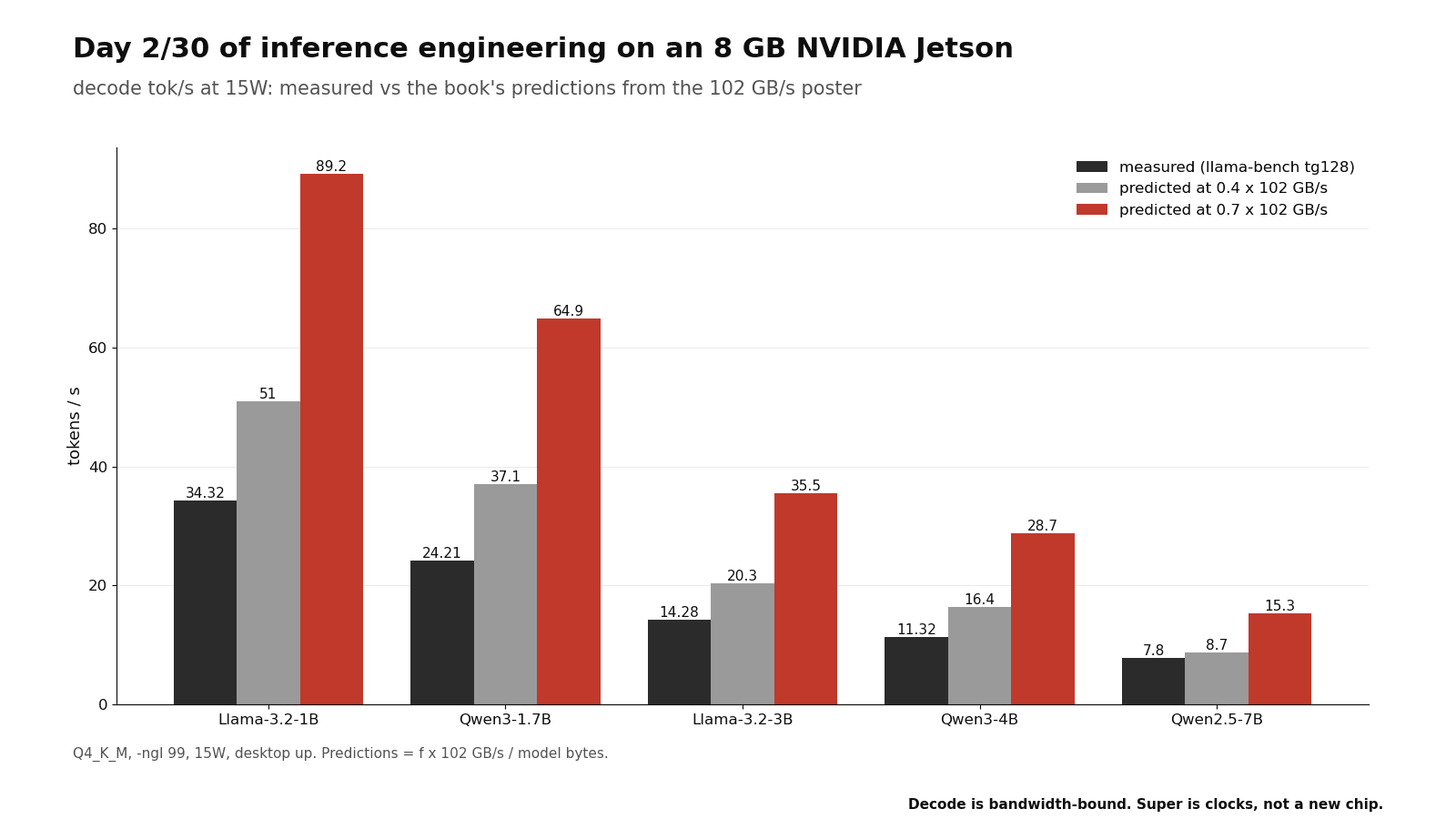
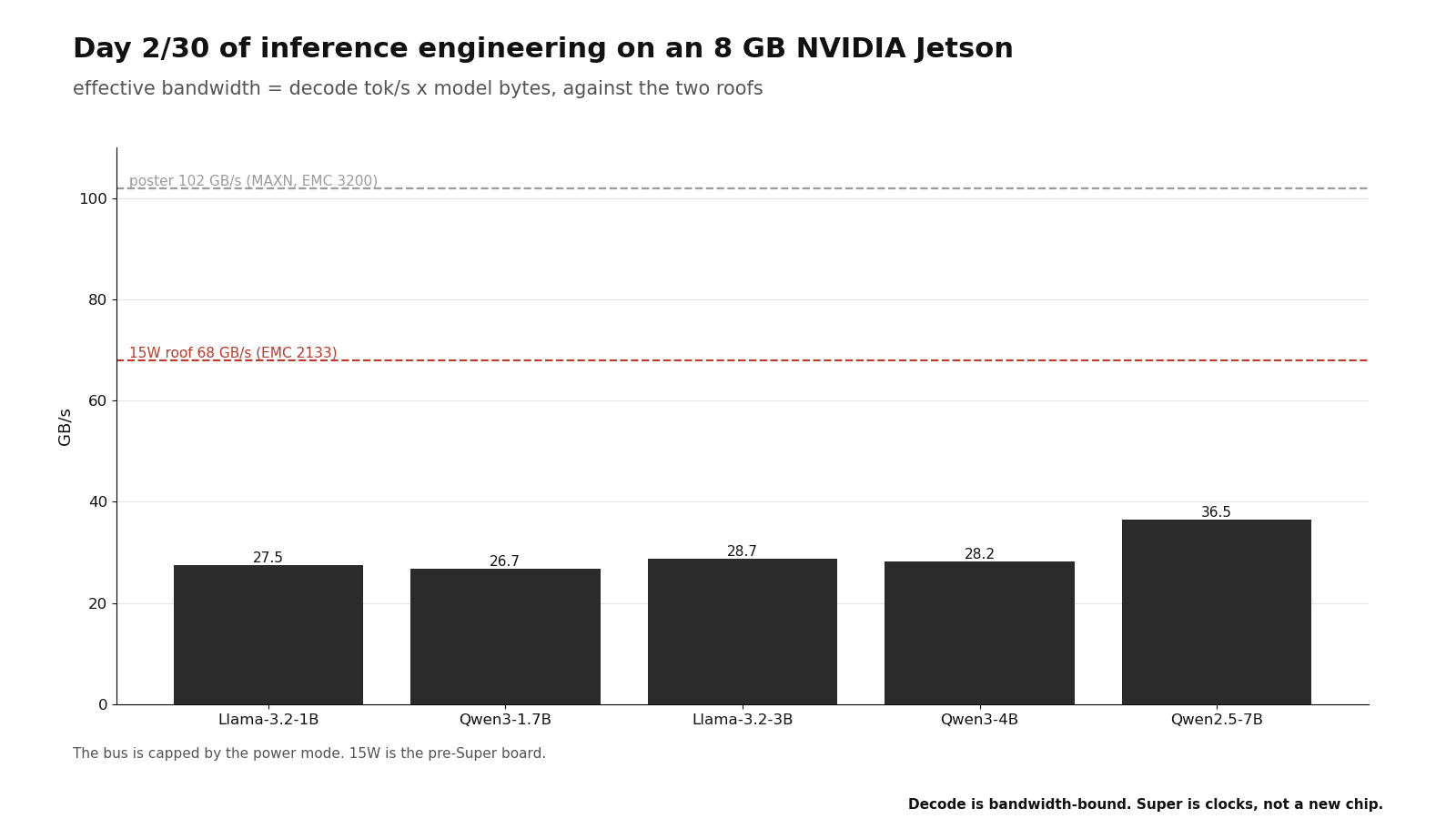
- At 15W the caps are 612 MHz GPU and 2133 MHz memory clock, not the poster clocks. Decode used 27 to 37 GB/s of a 68 GB/s roof, and the 4B ran at 11.3 tok/s, not the predicted 16.4.
What I expected
I took these predictions from the poster numbers, before the run.
- GPU clock cap, 15W mode: 1020 MHz (Super)
- Memory bus cap, 15W mode: 3200 MHz EMC clock (Super)
- Bandwidth roof at 15W: 102 GB/s poster
- INT8 peak at 15W: 67 TOPS poster
- Ridge point I* (ops/BW): 657 ops/B MAXN (my prior; sparse INT8 TOPS, not FLOP)
- Decode matvec intensity, Q4_K_M: 2/(4.5/8) = 3.6 FLOP/B
- Qwen3-1.7B decode tok/s: 37.1 / 64.9 (0.4x / 0.7x poster)
- Qwen3-4B decode tok/s: 16.4 / 28.7
- B_eff across 1B..7B: 0.4-0.7 x 10²
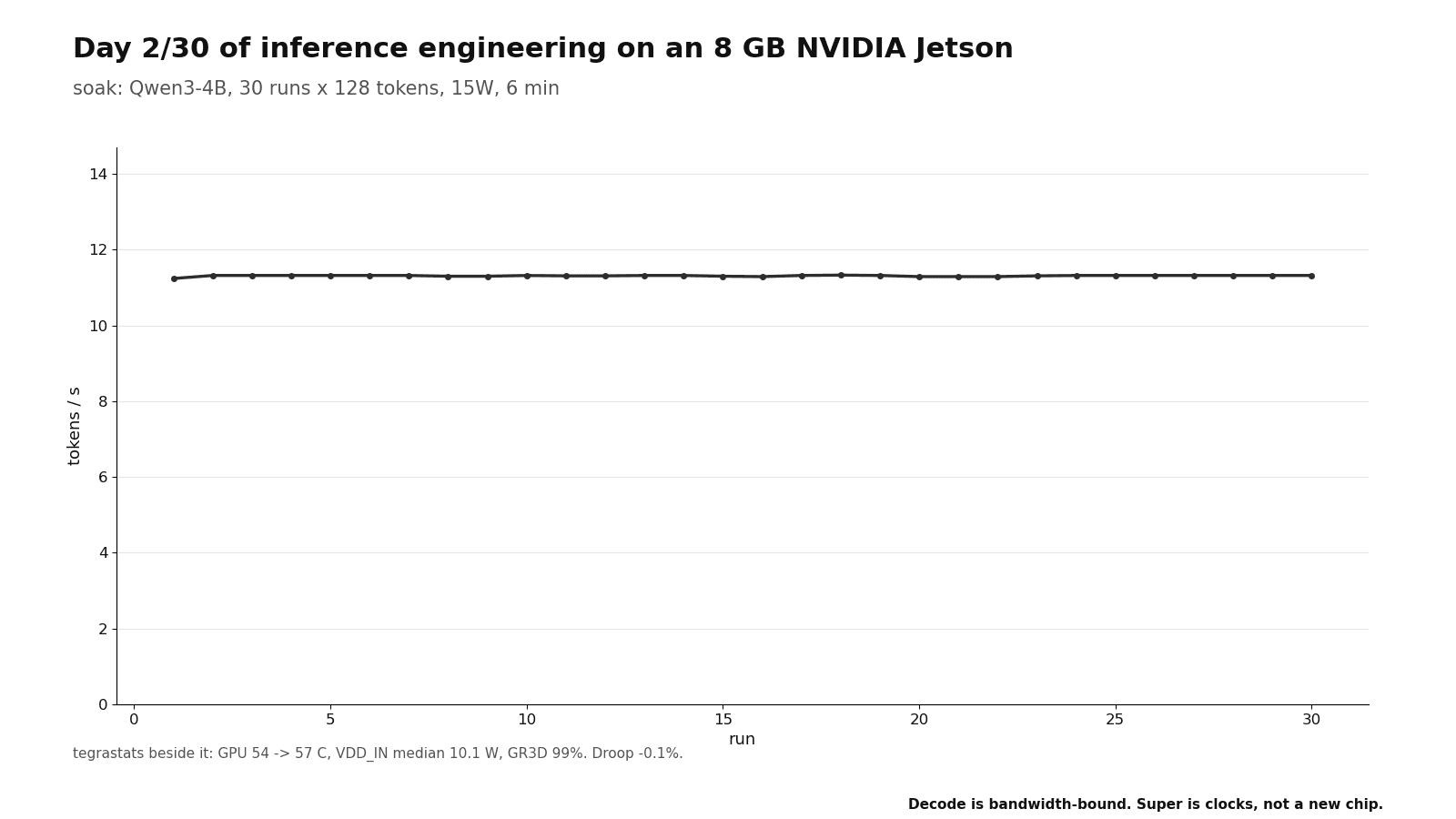
- Soak, Qwen3-4B 30x128 tok, 15W: droop if throttled
The theory
What TOPS measures, what decode needs
A chip has two limits. The first limit is how fast it can compute (TOPSTera-operations per second: a peak throughput figure, usually quoted for low-precision math under ideal conditions, that real models rarely approach.). The second limit is how fast it can move data (GB/s).
To generate one word, the chip reads each weight of the model one time. It does two very small multiplies for each weight that it reads.
That is a memory job, not a math job. The work reaches the GB/s limit first, and it never uses the TOPS.
THE ARITHMETIC: the ridge point
The ridge pointThe arithmetic intensity at which a roofline's bandwidth slope meets its compute ceiling; work below it is memory-bound and work above it is compute-bound. is peak FLOP/s / peak memory bandwidthHow many bytes per second the memory system can deliver; on a shared-memory board the CPU, GPU and video engines all draw from the same supply.. Use the number format that the work uses.
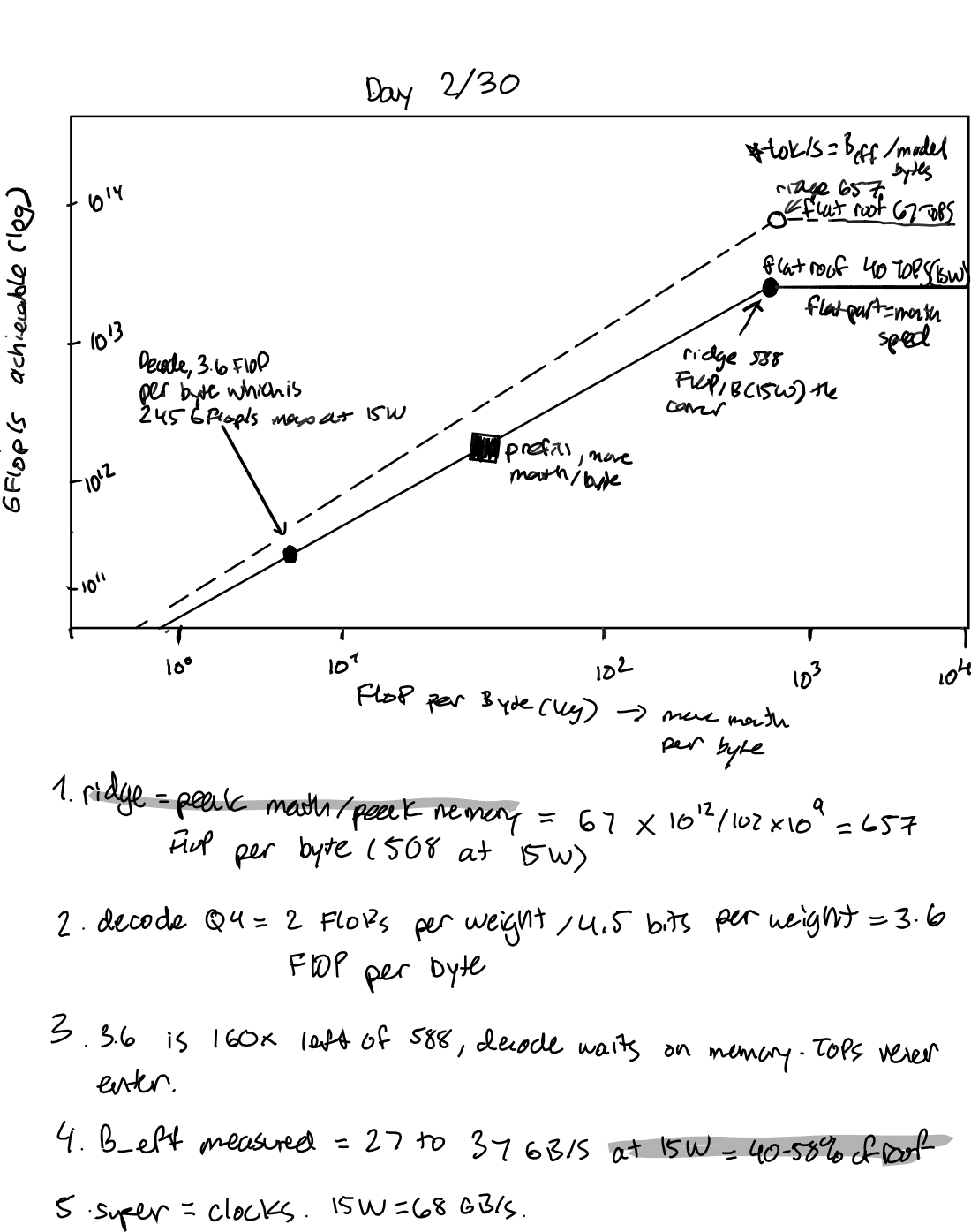
The poster gives 67 TOPS / 102 GB/s = 657. But those TOPS are sparse INT8An 8-bit integer number format; it shrinks weights and activations relative to floating point but needs calibration or scaling to keep accuracy.. So 657 is INT8 ops per byte. It is not a FLOP ridge.
At 15W, FP32Standard 32-bit floating point (single precision), the usual training format and the accuracy reference for lower-precision runs. on the CUDA cores gives 1024 cores x 2 FLOP x 612 MHz = 1.25 TFLOP/s. This is spec arithmetic. The ridge is 1.25 TFLOP/s / 68 GB/s = 18 FLOP per byte.
decodeThe phase after prefill where a language model generates one token at a time and re-reads its weights for each one; it is usually limited by memory bandwidth. needs 3.6 FLOP per byte. This is 5x below the 15W fp32 ridge.
The 3200 and 2133 are EMC clock frequencies in MHz, from nvpmodel.conf. LPDDR5 moves two transfers for each clock. So 3200 MHz is 6400 MT/s, and 128 bits x 6400 MT/s = 102 GB/s. The 15W roof is 102 x 2133 / 3200 = 68 GB/s.
The setup
nvpmodel -q                                   # -> 15W (mode 0)
cat /sys/class/devfreq/17000000.gpu/max_freq   # -> 612000000  (available up to 1020000000)
grep -A30 'POWER_MODEL ID=0' /etc/nvpmodel.conf | grep -E 'GPU MAX|EMC MAX'   # 612 MHz, 2133 MHz
# roof at 15W = 102 GB/s x 2133/3200 = 68 GB/s. INT8 = 67 x 612/1020 = 40 TOPS.B=~/llama.cpp/build/bin/llama-bench; MD=~/models
for f in Llama-3.2-1B-Instruct Qwen3-1.7B Llama-3.2-3B-Instruct Qwen3-4B Qwen2.5-7B-Instruct; do
$B -m $MD/$f-Q4_K_M.gguf -ngl 99 -p 512 -n 128 -r 3 -o json > ~/day02/bench_$f.json; done
# tg128 avg_ts = decode tok/s. B_eff = avg_ts x model_size bytes. pp512 = prefill.tegrastats --interval 2000 > ~/day02/tegra_soak.log &
$B -m $MD/Qwen3-4B-Q4_K_M.gguf -ngl 99 -p 0 -n 128 -r 30 -o json > ~/day02/soak_4b.json
kill %1; python3 -c "import json;print(json.load(open('$HOME/day02/soak_4b.json'))[0]['samples_ts'])"
# droop = first five vs last five. gpu@..C and VDD_IN in the tegra log.Environment and scripts
- Board: Jetson Orin Nano Super, L4T R36.4.2 (from measured.json).
- Power mode: 15W (nvpmodel 0), found, not pinned. Caps: GPU 612 MHz, memory 2133 MHz.
- llama.cpp: build 3466812 (build_commit in each bench JSON).
- Decode and prefill: llama-bench, the loop above, one bench_<model>.json per model.
- Soak: llama-bench plus tegrastats, soak_4b.json and tegra_soak.log.
- Live token trace: tools/day02_live.py, live.json.
"prompt": "Explain in three sentences why an 8 GB Jetson shares one memory between the CPU an...
"runs": [ ... ]
"t0": 65039.38
"samples": [ ... ]
The measurement
| What | Expected | Measured | Note |
|---|---|---|---|
| GPU clock cap, 15W mode | 1020 MHz (Super) | 612 MHz | devfreq max_freq; MAXN allows 1020 |
| Memory bus cap, 15W mode | 3200 MHz EMC clock (Super) | 2133 MHz | /etc/nvpmodel.conf EMC MAX_FREQ. Both are EMC clock MHz, not MT/s |
| Bandwidth roof at 15W | 102 GB/s poster | 68 GB/s (estimate) | 102 x 2133/3200, from the cap |
| INT8 peak at 15W | 67 TOPS poster | ~40 TOPS (estimate) | 67 x 612/1020, from the cap |
| Ridge point I* (ops/BW) | 657 ops/B MAXN (sparse INT8 TOPS) | 18 FLOP/B fp32 at 15W (spec arithmetic) | 1.25 TFLOP/s / 68 GB/s; INT8 TOPS are not FLOP |
| Decode matvec intensity, Q4_K_M | 2/(4.5/8) = 3.6 FLOP/B | 5x below the fp32 ridge (spec arithmetic) | bandwidth-bound |
| Qwen3-1.7B decode tok/s | 37.1 / 64.9 (0.4x / 0.7x poster) | 24.21 tok/s | B_eff 26.7 GB/s |
| Qwen3-4B decode tok/s | 16.4 / 28.7 | 11.32 tok/s | B_eff 28.2 GB/s |
| B_eff across 1B..7B | 0.4-0.7 x 10² | 27-37 GB/s | = 0.39-0.54 of the 68 GB/s 15W roof |
| Prefill pp512 tok/s 1B..7B | - | 1450 / 957 / 553 / 414 / 267 | the compute-bound side |
| Soak, Qwen3-4B 30x128 tok, 15W | droop if throttled | 11.3 -> 11.3 tok/s, +0.1% | first five 11.31, last five 11.32; gpu 54->57 C, 10.1 W, 6 min; no throttle |
TWO RECEIPTS: POSTER CLOCK vs THE MODE I RUN
Poster (MAXN SUPER)
GPU clock    1020 MHz
memory bus   3200 MHz
= = 67 TOPS, 102 GB/s
15w (measured)
GPU clock     612 MHz
memory bus   2133 MHz
= = ~40 TOPS, 68 GB/s
Super is a clock setting on the same chip. It is not a different chip.
ONE DECODE STEP, weight by weight
- Read oneweight (4.5 bit)
- 2 tinymultiplies
- Write thepartial sum
- Nextweight
decode tok/s at 15W (llama-bench)
- 1B
- 34.3
- 1.7B
- 24.2
- 3B
- 14.3
- 4B
- 11.3
- 7B
- 7.8
EFFECTIVE BANDWIDTH vs THE 68 GB/s ROOF
Line at 68 roof
| item | predicted | measured |
|---|---|---|
| 1.7B decode | 37.1 (0.4x poster) | 24.21 tok/s |
| 4B decode | 16.4 (0.4x poster) | 11.32 tok/s |
| B_eff, 1B..7B | 0.4-0.7 x 102 GB/s | 27-37 GB/s |
Where it broke
The poster said 102 GB/s and 67 TOPS. The board at 15W caps the GPU at 612 MHz and the memory clock at 2133 MHz, so the roof is 68 GB/s. My tok/sTokens per second: how fast a language model reads a prompt (prefill) or writes output (decode); the two rates are different numbers. predictions came from the poster and were too high: 16.4 against 11.3 for the 4B. Decode used 27 to 37 GB/s of the 68. The soak did not droop: the last five runs were 0.1% faster than the first five.
My notes from Day 2
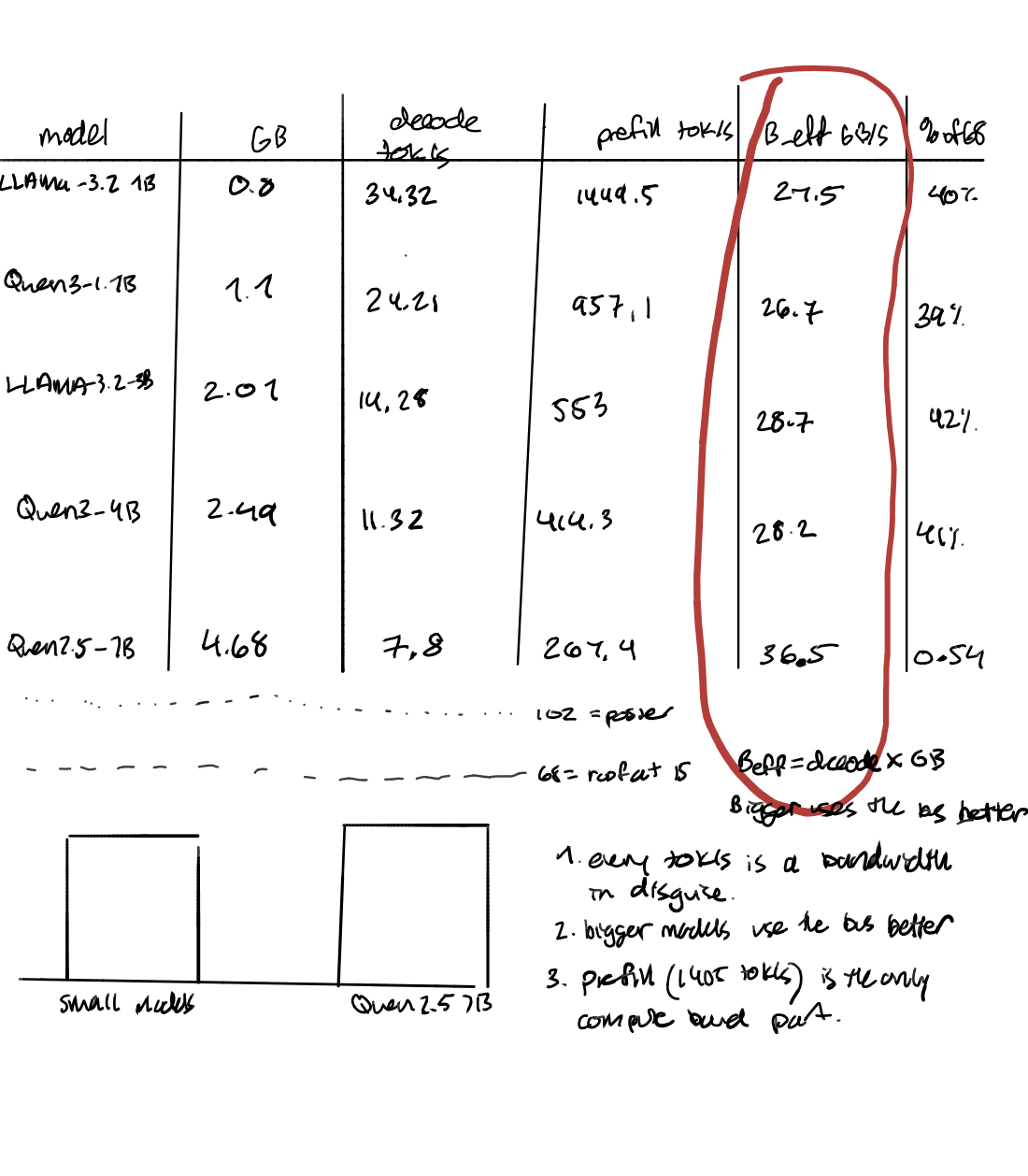
Written by hand on 2026-09-02, before this chapter was typed. These are my original notes from that day. Where the chapter corrects them, the chapter is current.
Summary
- Tok/s x model bytes gives the bandwidth that decode used. Here it was 27 to 37 GB/s. That is 39% to 54% of the 68 GB/s roof at 15W.
- Larger models use the bus better. Small models have a fixed cost for each token. This cost has no relation to bandwidth.
- prefillThe first phase of language-model inference, where the whole prompt is processed in one parallel pass to fill the KV cache; it is usually limited by compute. is the read of the prompt. Compute is important in prefill. The 1B read 1450 tok/s of prompt and decoded 34.3 tok/s.
Sources
These sources are not mine. Measured numbers came off my own board; specs, estimates and paper figures are labeled as such.
- JetPack 6.2 Super-mode blog (Orin Nano 8GB 15/25W/MAXN SUPER, 67 TOPS sparse INT8, ~102 GB/s)
- Roofline: Williams, Waterman, Patterson
- Orin Nano datasheet clocks (GPU 625 MHz base / 1020 MHz Super class)
- Orin Nano Super spec: 1024 CUDA cores (fp32 peak = cores x 2 FLOP x clock)