The 8 GB Lab Book · Chapter 3
The fit equation: weights + KV + vision
- Board
- Jetson Orin Nano Super
- Mode
- 15W
- Setup
- L4T R36.4.2
- Summary
- KV cost per token comes from three numbers in the model file: 144 KB for Qwen3-4B, 56 KB for Qwen2.5-7B. llama.cpp's log matched to the byte. The 4B at 32,768 tokens passed my 7,200 MB guard at 7,350 MB and was killed; llama.cpp's fit check said 2288 MiB too much, and I read that as a wall near 16.5k tokens. On 2026-10-04 the same model loaded and answered at 24,576 tokens; my guard killed it at 26,624.
What I expected
I computed these values from the model configs before the run.
- Qwen3-1.7B: KV per token (f16): 2x28x8x128x2 B
- Qwen3-4B: KV per token (f16): 2x36x8x128x2 B
- Qwen2.5-7B: KV per token (f16): 2x28x4x128x2 B
- Llama-3.2-3B: KV per token (f16): 2x28x8x128x2 B
- gemma-3n-E2B: KV per token (f16): 2x30x2x256x2 B
- Qwen3-1.7B pile at ctx 512: 2656 MB (w+1.5 GB+KV)
- Qwen3-1.7B pile at ctx 16384: 4392 MB (w+1.5 GB+KV)
- Qwen3-4B pile at ctx 512: 4062 MB (w+1.5 GB+KV)
- Qwen3-4B pile at ctx 16384: 6294 MB (w+1.5 GB+KV)
- Qwen2.5-7B pile at ctx 512: 6208 MB (w+1.5 GB+KV)
- Qwen2.5-7B pile at ctx 16384: 7076 MB (w+1.5 GB+KV)
- Qwen3-4B at ctx 32768 (the wall): 2.49 GB + 4.6 GB KV + scratch
The theory
Why the cache exists
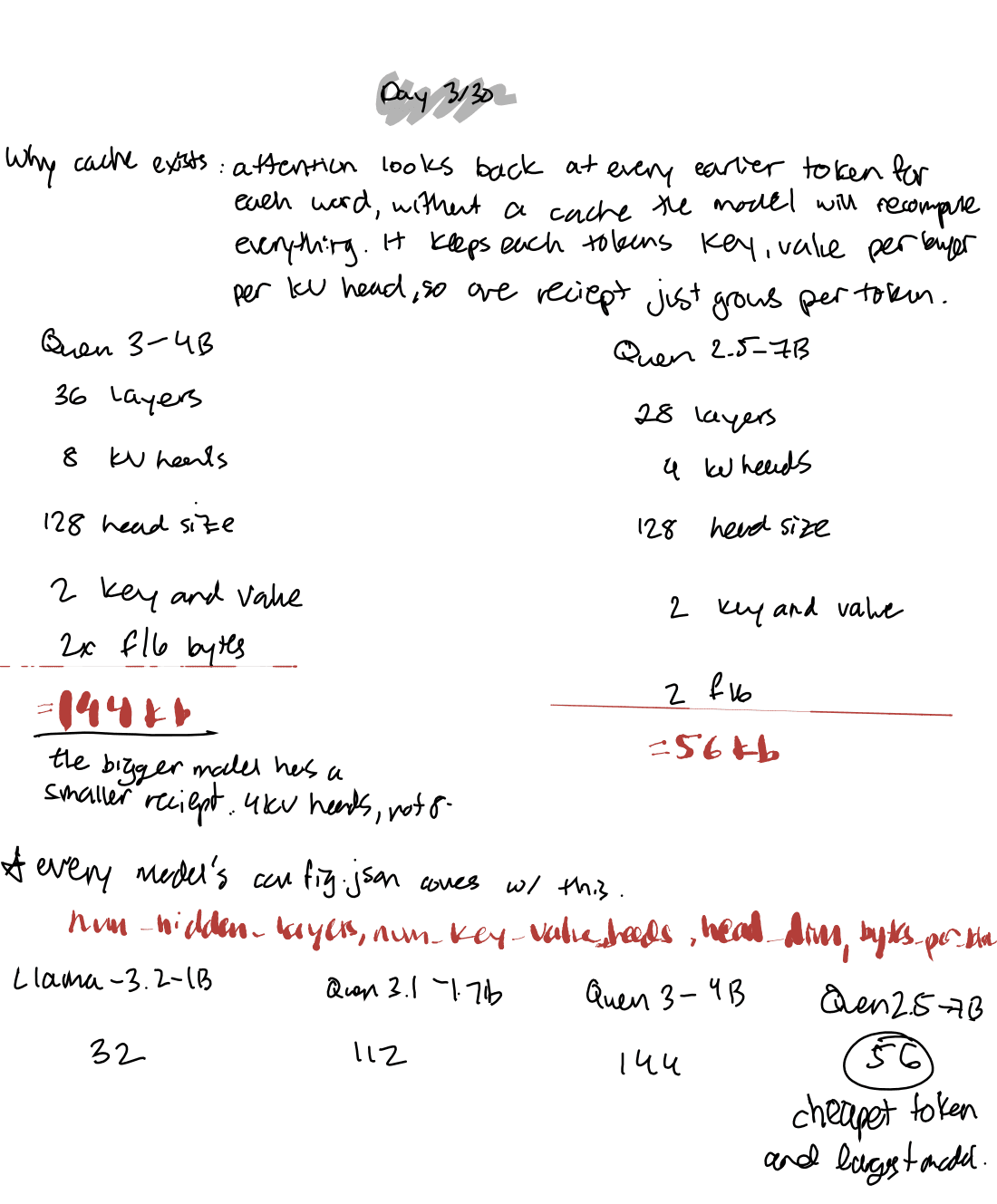
For each new word, attention examines each earlier token. Without a cache, the model would compute all of them again at each step.
The model keeps the key and the value of each token, for each layer and for each KV head. This is the KV cacheThe attention keys and values a transformer has already computed for earlier tokens, kept in memory so each new token does not recompute them; it grows with context length.. The cache uses memory to get speed. It grows by one entry for each token.
Where the three numbers live (config.json of any model)
Num_hidden_layers = 36, num_key_value_heads = 8 and head_dim = 128. These are the three numbers.
The number of bytes per token is layers x kv_heads x head_dim x 2 x 2.
THE CHECK, from llama.cpp's own log
The log gives Llama_kv_cache: size = 576 MiB vs MBA mebibyte (MiB) is 2^20 bytes and a megabyte (MB) is 10^6 bytes; some tools label MiB as "MB", so check which one a tool actually counts. at n_ctx 4096.
144 KB x 4096 = 589,824 KB = 576 MiB. The match is exact to the byte.
THE ARITHMETIC, worked for the 4B
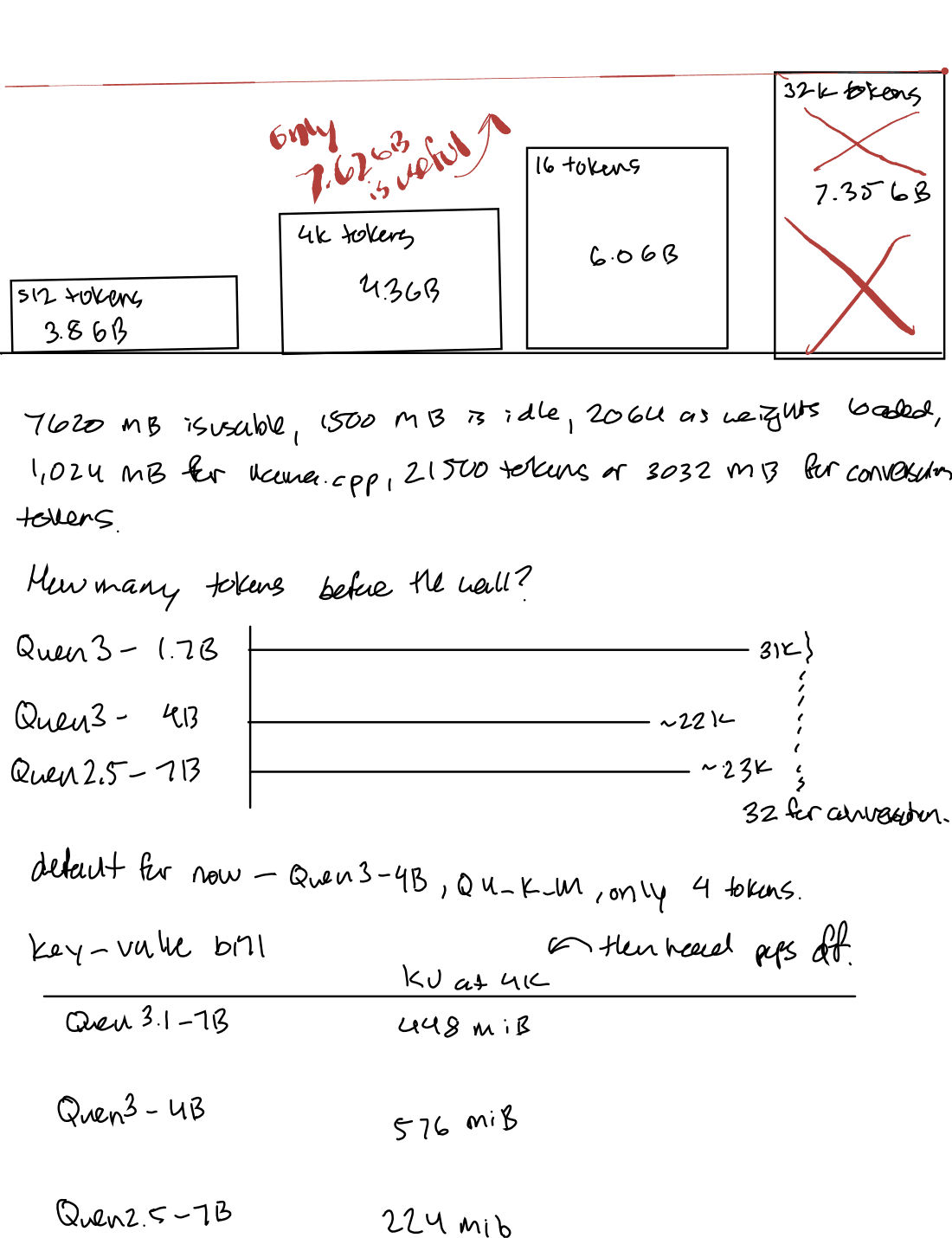
7,620 is usable.
Subtract 1,500 for the idle floor. After a day of loading, the driver keeps pages.
Subtract 2,064 for the weights as loaded. This is the measured delta at 512 tokens, minus its very small KV.
Subtract the 1,024 that llama.cppAn open-source C/C++ inference engine for language models that runs GGUF files on CPUs and GPUs, including CUDA on Jetson. keeps free before it refuses.
The result is 3,032 MB of headroom for conversation. 3,032 MB / 144 KB = ~21,500 tokens. This is the floor formula, not a run.
I asked for 32,768. The live run climbed to 7,350 MB, and my guard at 7,200 MB killed the server. A second attempt (wall.txt) exited on its own at load, peak 6477 MB. llama.cpp said it must reduce device memory by 2288 MiB to keep 1024 MiB free. KV at 32k is 4608 MiB, so about 16.5k tokens would fit (arithmetic). No context between 16k and 32k ran. Rerun 2026-10-04: contexts 20,480 and 24,576 loaded and answered, peak 6,493 and 7,064 MB; 26,624 and 28,672 hit the 7,200 MB guard at 7,291 and 7,422 MB. The 'reduce device memory' line printed at every one of those contexts and the load went on: it is a warning about a 1,024 MiB free target, not a refusal, so the 16.5k arithmetic was wrong. The wall is between 24,576 and 26,624 tokens.
The setup
~/llama.cpp/build/bin/llama-server -v -m ~/models/Qwen3-4B-Q4_K_M.gguf -c 4096 2>&1 | grep -E 'n_layer|n_head_kv|n_embd_head_k|KV buffer'
# KB/token = 2 x n_layer x n_head_kv x n_embd_head_k x 2 bytes / 1024 (f16 K and V)bash ~/day03_sweep.sh
cat ~/day03/sweep.tsv
# pile = tegrastats RAM used with the server up at that -ccat ~/day03/wall.txt
# a loop kills the server if RAM used passes 7200 MB. Day 1 taught why."model": "Qwen3-4B Q4_K_M" "size_gb": 2.497 "kb_per_token": 144 "events": [ ... ] "samples": [ ... ]
The measurement
| What | Expected | Measured | Note |
|---|---|---|---|
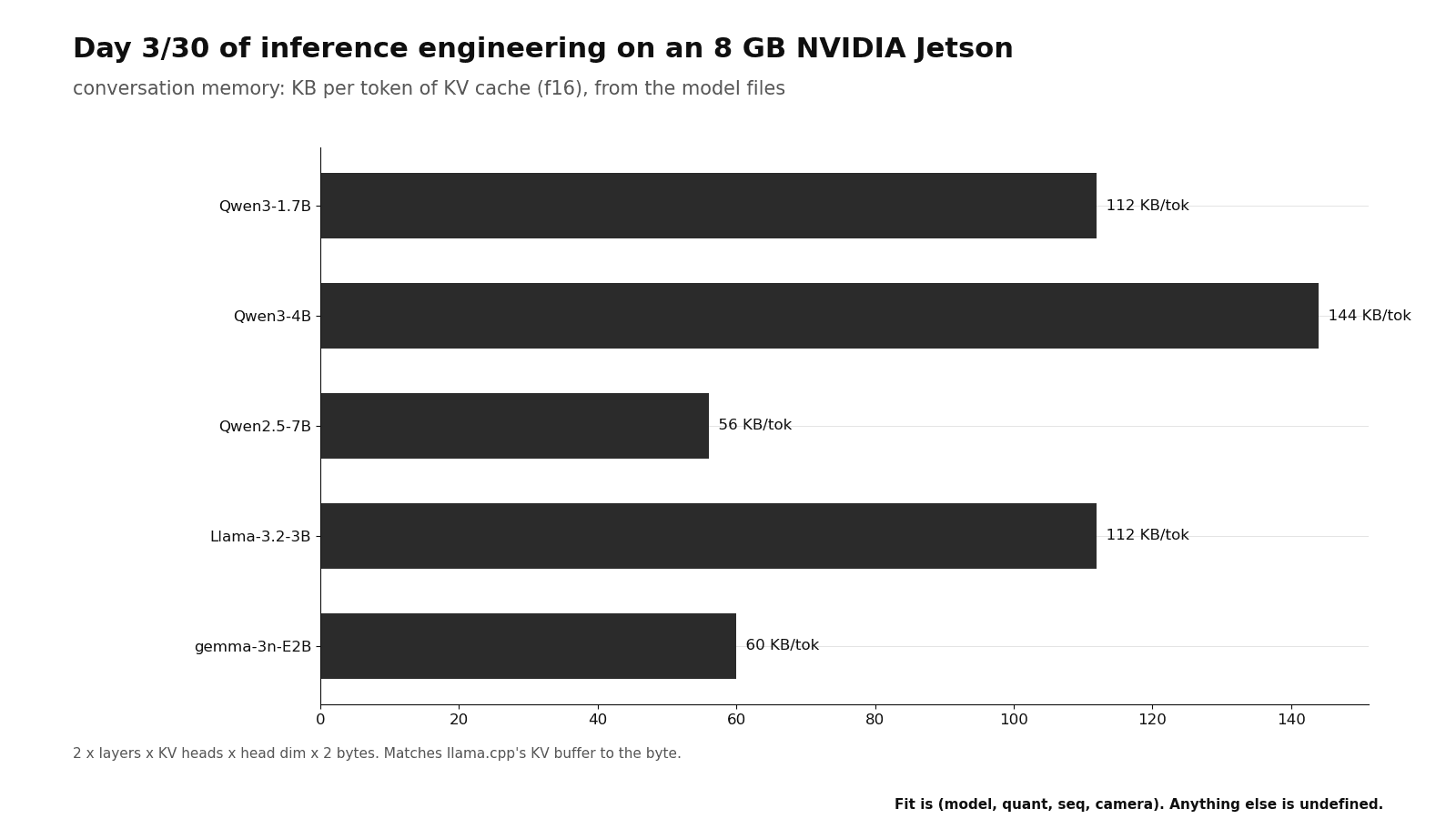
| Qwen3-1.7B: KV per token (f16) | 2x28x8x128x2 B | 112 KB/tok | llama.cpp KV buffer / n_ctx |
| Qwen3-4B: KV per token (f16) | 2x36x8x128x2 B | 144 KB/tok | llama.cpp KV buffer / n_ctx |
| Qwen2.5-7B: KV per token (f16) | 2x28x4x128x2 B | 56 KB/tok | llama.cpp KV buffer / n_ctx |
| Llama-3.2-3B: KV per token (f16) | 2x28x8x128x2 B | 112 KB/tok | llama.cpp KV buffer / n_ctx |
| gemma-3n-E2B: KV per token (f16) | 2x30x2x256x2 B | 28 KB/tok at 4096 (log) | log: non-SWA cache 32 MiB (4 layers x 4096 cells) + SWA cache 80 MiB (16 layers x 2560 cells) = 112 MiB. 20 of 30 layers hold KV: 40 KB/tok before the window, 28 with it. 60 is the formula |
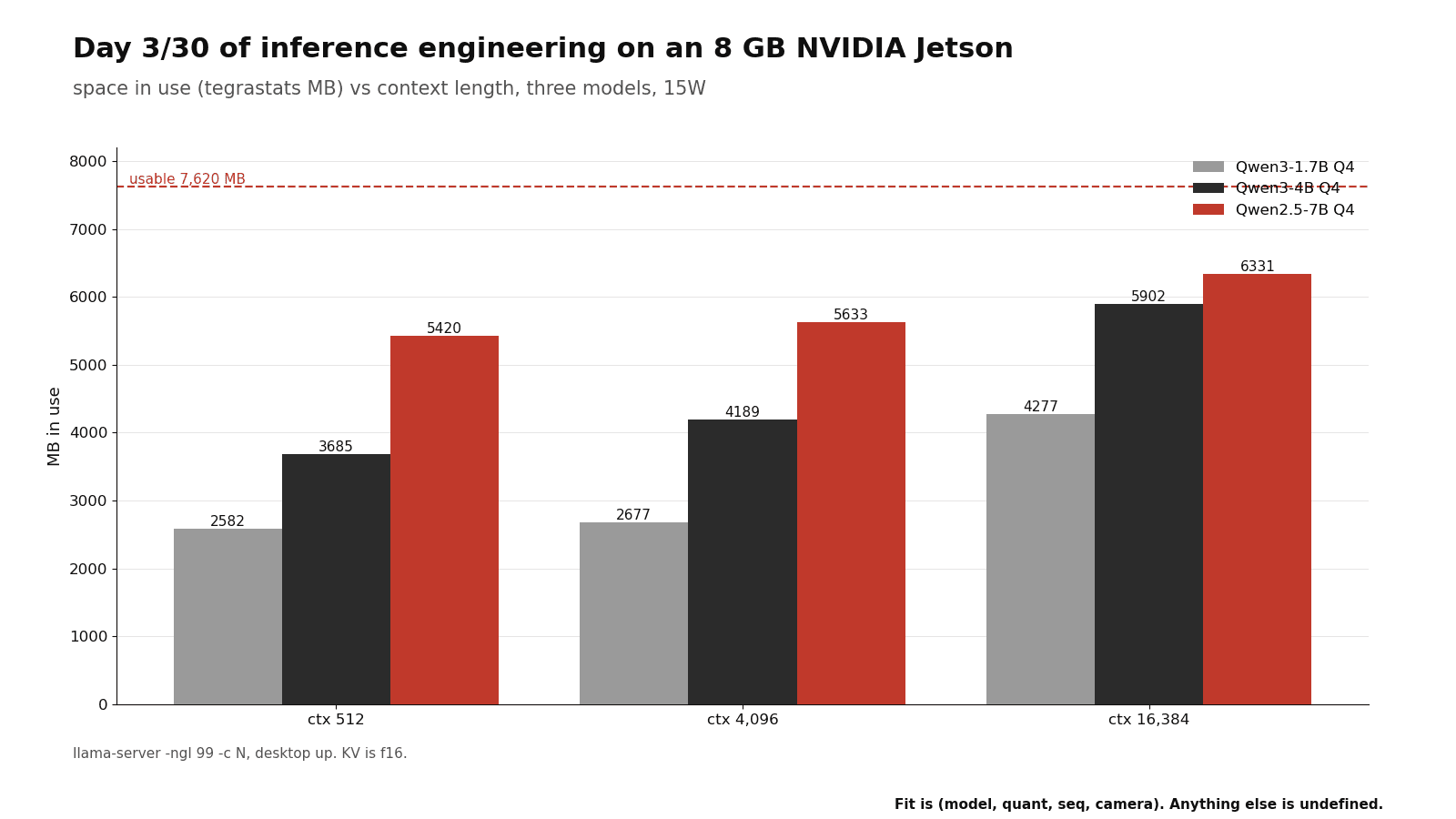
| Qwen3-1.7B pile at ctx 512 | 2656 MB (w+1.5 GB+KV) | 2582 MB (+1787 over idle 795) | KV 56 MiB, scratch 49 MiB |
| Qwen3-1.7B pile at ctx 16384 | 4392 MB (w+1.5 GB+KV) | 4277 MB (+2737 over idle 1540) | KV 1792 MiB, scratch 64 MiB |
| Qwen3-4B pile at ctx 512 | 4062 MB (w+1.5 GB+KV) | 3685 MB (+2136 over idle 1549) | KV 72 MiB, scratch 76 MiB |
| Qwen3-4B pile at ctx 16384 | 6294 MB (w+1.5 GB+KV) | 5902 MB (+4361 over idle 1541) | KV 2304 MiB, scratch 91 MiB |
| Qwen2.5-7B pile at ctx 512 | 6208 MB (w+1.5 GB+KV) | 5420 MB (+3855 over idle 1565) | KV 28 MiB, scratch 133 MiB |
| Qwen2.5-7B pile at ctx 16384 | 7076 MB (w+1.5 GB+KV) | 6331 MB (+4851 over idle 1480) | KV 896 MiB, scratch 148 MiB |
| Qwen3-4B at ctx 32768 (the wall) | 2.49 GB + 4.6 GB KV + scratch | guard killed it at 7,350 MB (live.json); the retry exited at load, peak 6477 MB (wall.txt) | llama.cpp: reduce device memory by 2288 MiB |
| Qwen3-4B at ctx 20480 / 24576 / 26624 / 28672 (rerun 2026-10-04, one try each) | KV 2880 / 3456 / 3744 / 4032 MiB | answered / answered / guard / guard; peaks 6,493 / 7,064 / 7,291 / 7,422 MB | answers in 2,981 and 2,777 ms; the guard is my 7,200 MB rule, not llama.cpp; the 'reduce device memory' line printed every time (546 / 1108 / 1418 / 1723 MiB) and the load continued |
| practical max context, Qwen3-1.7B | - | ~31k tokens (estimate) | floor formula, not run |
| practical max context, Qwen3-4B | - | 24,576 tokens (run, 2026-10-04) | largest context that loaded and answered under the 7,200 MB guard; 26,624 hit the guard. Day 3 said ~16.5k from (4608 - 2288) MiB / 144 KB: that shortfall line is a warning, not a refusal, so the arithmetic was wrong; the floor formula gives ~21,500 |
| practical max context, Qwen2.5-7B | - | ~23k tokens (estimate) | 4 KV heads; floor formula, not run |
Two receipts side by side
Qwen3-4B
layers          x 36
KV heads        x 8
head size       x 128
key AND value   x 2
f16 bytes       x 2
= = 147,456 B = 144 KB
Qwen2.5-7B
layers          x 28
KV heads        x 4
head size       x 128
key AND value   x 2
f16 bytes       x 2
= = 57,344 B = 56 KB
The larger model has the smaller entry. It has 4 KV heads, not 8.
the price list, KB per token
- Llama-3.2-1B
- 32
- Qwen3-1.7B
- 112
- Qwen3-4B
- 144
- Qwen2.5-7B
- 56
- gemma-3n-E2B (log, 4k)
- 28
FOUR BLOCKS, one per load (rectangles, taller as the number grows)
Line at 7.62 GB usable
Three bars: tokens of conversation before the wall
Line at 32k asked
| model | KV at 4k | note |
|---|---|---|
| Qwen3-1.7B | 448 MiB | |
| Qwen3-4B | 576 MiB | my default |
| Qwen2.5-7B | 224 MiB | 4 KV heads |
Where it broke
The KV arithmetic held: 144 KB x 4096 = 576 MiB, and llama.cpp allocated 576 MiB. All six pile predictions were too high, by 74 to 788 MB, because my 1.5 GB floor was larger than the idle the sweep saw. The 4B at 32k did not fit. My guard killed it at 7,350 MB, and llama.cpp's own check said 2288 MiB too much. On Chapter 3 I never ran a context between 16k and 32k, so the practical maximum was arithmetic. On 2026-10-04 I did: 24,576 loaded and answered at a 7,064 MB peak and 26,624 hit the guard at 7,291. The shortfall line was a warning, not a refusal, and the wall is near 24.5k, not 16.5k.
My notes from Day 3
Written by hand on 2026-09-02, before this chapter was typed. These are my original notes from that day. Where the chapter corrects them, the chapter is current.
Summary
- Set the context length deliberately. It is the second largest memory setting, after the model itself. It is the only setting that grows while the robot talks.
- Use KB per token to judge the memory of a model. Do not use the parameter count. The 7B used less memory per token than the 4B.
- A default is (model, quantizationStoring a model's weights, and sometimes its activations, in fewer bits, trading a little accuracy for less memory and less memory traffic., context, camera on). Without all of these items, it is not a default. My default for now is: Qwen3-4B, Q4_K_M, 4k, camera on.
Sources
These sources are not mine. Measured numbers came off my own board; specs, estimates and paper figures are labeled as such.
- Llama / Qwen model cards (GQA)
- Jetson AI Lab SLM guide: Nano 8GB comfort zone 1–4B Q4
- 7B Q4 is a science project with a camera
- NVIDIA posts listing Gemma 4 E2B as the Nano Gemma
- day03/rerun-2026-10-04/summary.json: Qwen3-4B Q4_K_M at 20480, 24576, 26624 and 28672 tokens on 2026-10-04, one try each, guard at 7,200 MB (wall.tsv, server logs, tegrastats)