The 8 GB Lab Book · Chapter 29
Policy Hz vs. control Hz
- Rig
- MuJoCo sim of the biped
- Mode
- sim
- Summary
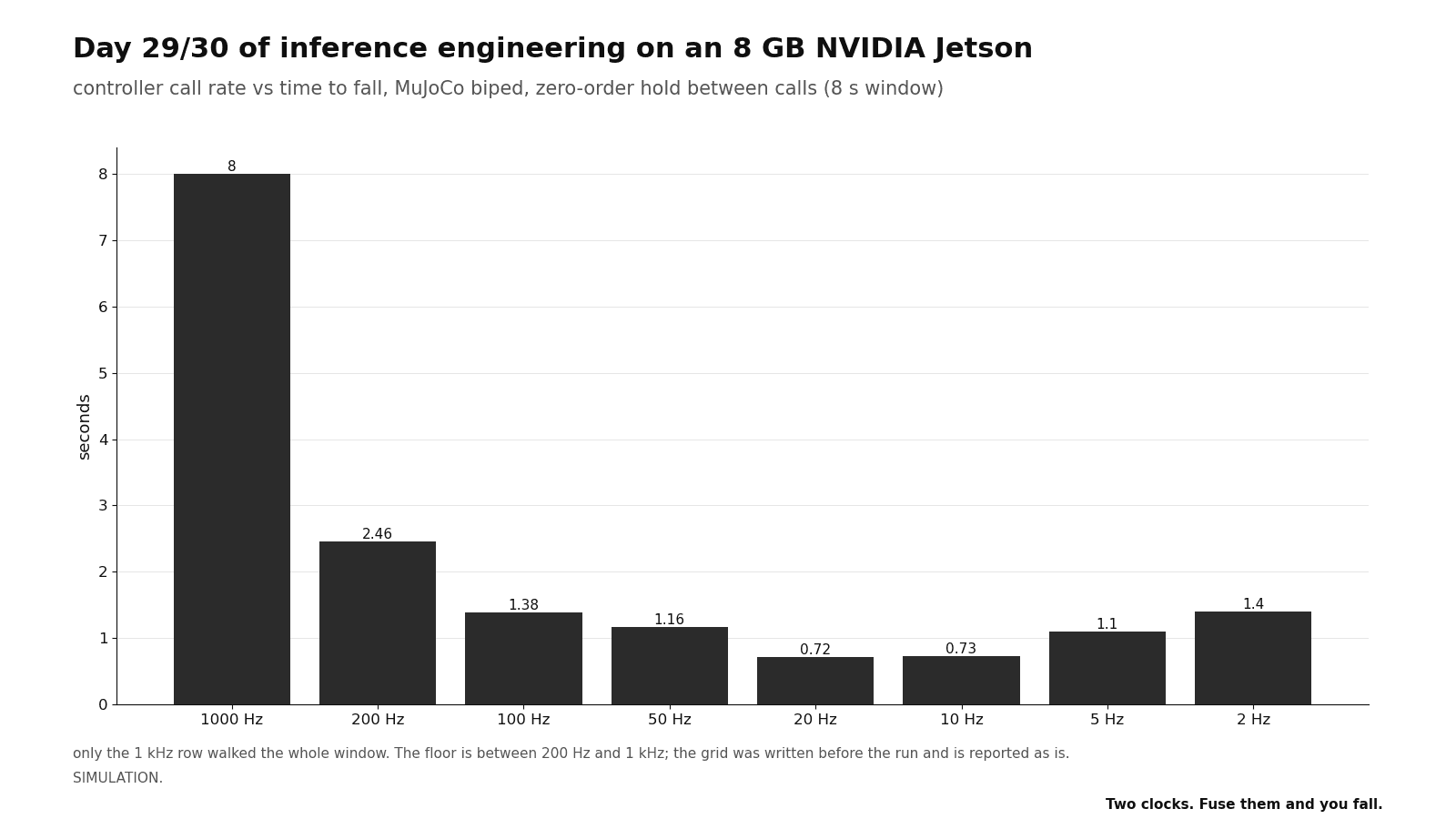
- In the sim the same controller walked 1.19 m at 1000 Hz and fell at every rate I tried from 200 Hz down. 200 Hz lasted longest, 2.46 s.
What I expected
The textbook set my prior: a threshold near 100 Hz. The textbook says to sample ten to twenty times faster than the loop that you close. The guess of Chapter 28 put this loop near 5 to 8 Hz. I expected that 50 to 160 Hz would be sufficient. Before the run, I wrote 'up' next to 1000 and 200 and 'falls' next to 100 and below.
I also expected that the Hz of the policy HzHow often a learned policy produces a new action or action chunk; between outputs, the controller below it has to keep the robot stable on its own. would be the important number today. It was the least interesting number on the page.
The theory
A zero-order hold is a delay of half a period, so Day 28 already predicted today
Zoh as delay (arithmetic)
T = 1 / f;  1 / Hz = s
effective delay = T / 2 on average
1000 Hz: 0.5 ms    200 Hz: 2.5 ms
20 Hz: 25 ms   10 Hz: 50 ms   2 Hz: 250 ms
= Day 28 fell at 30 ms: 10 Hz (50 ms) and below must fall; 20 Hz, 25 ms, is under it and open
The two clocks (Day 26 + today)
inner: 1 kHz = 1,000 torque writes per s
outer: one 3B action step = 2,617 ms (Day 26, 640x360 image)
= 0.38 Hz at 640x360;  the 500M: 409 + 213 = 622 ms = 1.6 Hz
ratio: 1,000 / 0.38 = 2,600 ticks per intent
= one intent is 2,600 torque writes wide
The textbook rule is to sample at 10 to 20x the loop bandwidth. With the Chapter 28 guess of 5 to 8 Hz, the rule says 50 to 160 Hz is enough. The sim did not read the textbook: every rate under 1 kHz fell.
The sweep, three rows (sim, measured, 8 s window)
- 1000 Hz
- 1.19 m walked
- 200 Hz
- fell at 2.46 s
- 20 Hz
- fell at 0.72 s
The setup
cd ~/Documents/workspace/Walker-CAD/Something
python3 walking/render_two_clocks.py --vla-hz 2
cat output/day29/rate_sweep.json
The measurement
| What | Expected | Measured | Note |
|---|---|---|---|
| controller at 1000 Hz | up | walked 1.19 m | sim, ZOH between calls |
| controller at 200 Hz | up | fell at 2.46 s | sim, ZOH between calls |
| controller at 100 Hz | falls | fell at 1.38 s | sim, ZOH between calls |
| controller at 50 Hz | falls | fell at 1.16 s | sim, ZOH between calls |
| controller at 20 Hz | falls | fell at 0.72 s | sim, ZOH between calls |
| controller at 10 Hz | falls | fell at 0.73 s | sim, ZOH between calls |
| controller at 5 Hz | falls | fell at 1.10 s | sim, ZOH between calls |
| controller at 2 Hz | falls | fell at 1.40 s | sim, ZOH between calls |
| outer loop rate | a few Hz | Day 26 action JSON timing | sets intents |
Token to torque: three queues, and no torque in the outer loop
- Outer loopJSON action, 0.4 Hz at 640x360
- Mailboxlatest wins
- Intent layerfootstep target
- Inner loop1 kHz torque
| rate Hz | T/2 ms (arith.) | prior | fell at (s) | x at fall (m) |
|---|---|---|---|---|
| 1000 | 0.5 | up | - | 1.19 at 8 s |
| 200 | 2.5 | up | 2.46 | 0.13 |
| 100 | 5 | falls | 1.38 | -0.09 |
| 50 | 10 | falls | 1.16 | -0.01 |
| 20 | 25 | falls | 0.72 | -0.10 |
| 10 | 50 | falls | 0.73 | 0.19 |
| 5 | 100 | falls | 1.10 | 0.02 |
| 2 | 250 | falls | 1.40 | -0.35 |
| real inner loop | - | 1 kHz target | not measured yet | - |
Where it broke
200 Hz fell, and 2.5 ms of effective delay is a tenth of the 30 ms that caused the fall on Chapter 28. A ZOHZero-order hold: keep applying the last command unchanged until a new one arrives, which adds delay and turns a smooth signal into a staircase. is not only a delay. A held torque is also a staircase, where the body continues to move between calls and the torque does not. The next call then sees a larger error than the gains were tuned for. Either my crossover guess is low, or this controller depends on something that the textbook rule does not count.
The second result is that the two sweeps have one shape. Chapter 28 fell fastest at 60 ms of pure delay. Today the fastest falls were at 20 and 10 Hz, which is 25 and 50 ms of effective delay. The worst spot is in the same few tens of milliseconds both times. One controller, two knobs, one story. A zero-order-hold sweep cannot measure the sway frequency. The chirp test on Chapter 28's list still has to.
Summary
- The right side of the clip shows the result of "just run the policy slower". The result is not a slower walk. The result is a fall.
- The floor of this controller is between 200 Hz and 1 kHz. I fixed the grid of rates before the run.
- One 3B action step takes 2,617 ms (Chapter 26, at 640x360). In that time, the 1 kHz inner loop of the sim writes 2,600 torques.
Sources
These sources are not mine. Measured numbers came off my own board; specs, estimates and paper figures are labeled as such.
- LiteVLA-Edge (~150 ms / ~6.6 Hz on Orin-class)
- Jetson-PI foresight-aligned async inference
- Any locomotion stack (Isaac / cheap PD) on a 100 Hz dt