The 8 GB Lab Book · Chapter 8
TensorRT plugins when the graph has a hole
- Board
- Jetson Orin Nano Super
- Mode
- 15W
- Setup
- TensorRT 10.3
- Summary
- Folding the preprocess into the resnet18 engine cut end-to-end time from 6.27 ms to 5.31 ms per frame. The torch chain moves 50.7 MB per frame: 0.75 ms at the 68 GB/s roof, 1.55 to 1.6 ms at the 31 to 33 GB/s Chapter 7 measured. The 0.96 ms hole is a lower bound on its cost.
What I expected
I expected that dispatch caused the hole. There are a small number of launches and one sync before the TensorRT engineThe compiled, GPU-specific plan TensorRT produces from a network; it has to be rebuilt for a different GPU or TensorRT version. can start. I expected a gap of a few tenths of a millisecond. That is approximately the cost of the unfused preprocess on Chapter 7 (0.48 ms).
I also expected that a C++ plugin was necessary. It was not necessary. Each op in the preprocess is already an ONNXAn open file format that describes a neural network as a graph of standard operators, used to move a model from a training framework into a runtime such as TensorRT. op. The graph could include the preprocess, and I wrote nothing at the engine level.
The theory
The hole as a byte ledger: op order is a byte multiplier
Torch chain, outside (arithmetic)
cast u8 to f32, 720p: 2.76 + 11.06 = 13.8 MB
permute: a view, 0 MB
resize in f32: 11.06 + 3.69 = 14.7 MB
/255, -mean, /std: 3 x 7.4 = 22.1 MB
= = 50.7 MB and 5 launches per frame
Same job, day 7 fused
read u8 once: 2.76 MB
write f32 once: 3.69 MB
resize before the cast, in registers

= = 6.45 MB and 1 launch
This is 8x the bytes for the same tensor, because .float() runs before the resize. It makes an 11 MB copy of a 2.76 MB frame. The floor at the 68 GB/s roof is 50.7 / 68 = 0.75 ms. At the 31 to 33 GB/s that Chapter 7 measured, the same bytes take 1.55 to 1.6 ms. The hole measured 0.96 ms, so the hole is less than the chain at measured bus speed.
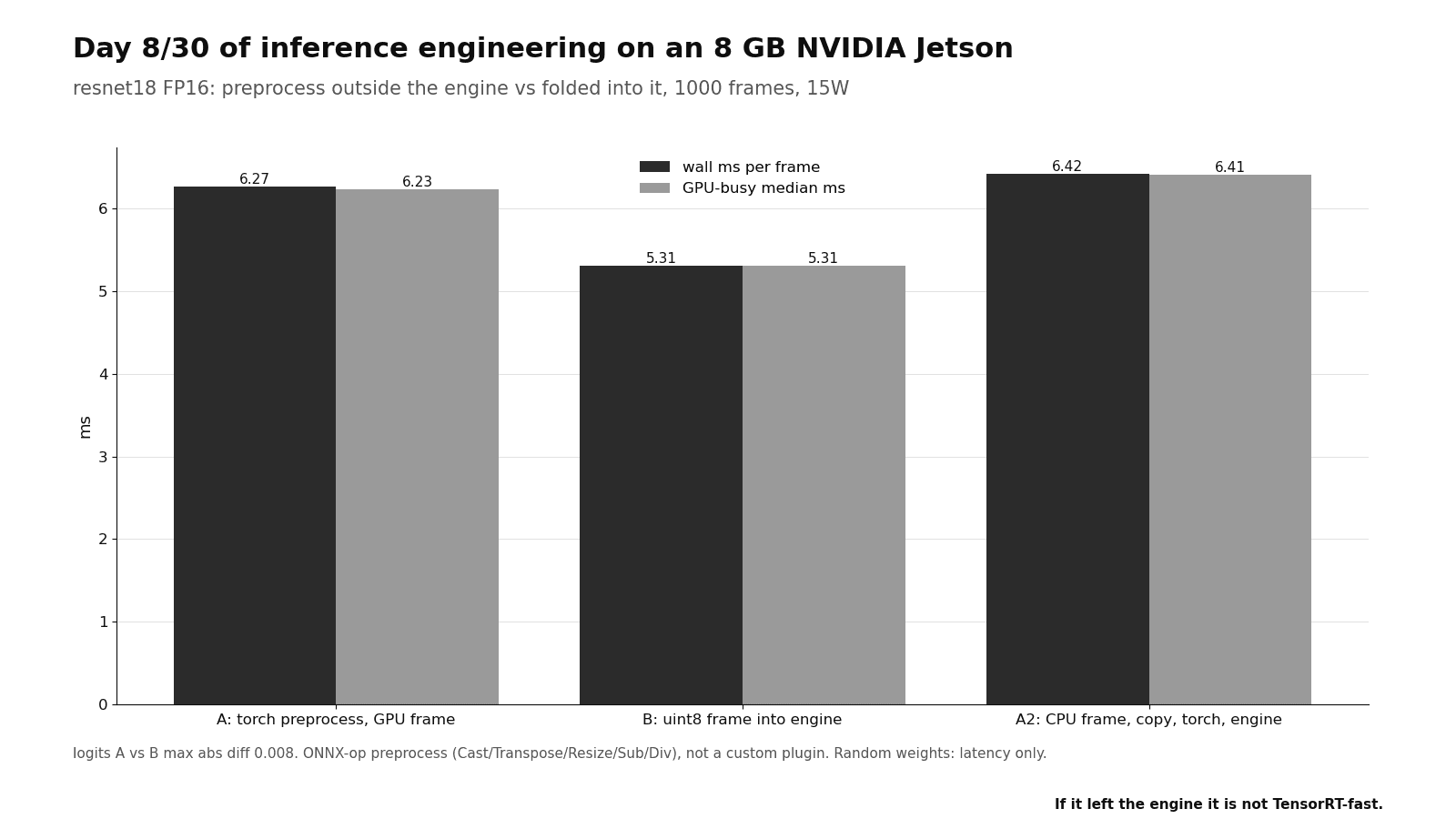
The hole, three ways (measured wall ms per frame, 1000 frames)
- A2, CPU frame
- 6.42
- A, GPU frame
- 6.27
- B, uint8 in
- 5.31
- A minus B
- 0.96
Two unit checks: the engine file, and the logit noise
resnet18 has 11.7 M weights (torchvision). In FP1616-bit floating point (half precision): half the bytes of FP32, and tensor cores run it at much higher throughput than FP32. that is 23.4 MB, and the engine file is 23.7 MB. The engine is the weights plus 0.3 MB of plan. The fold of the preprocess added 0.12 MB of plan and 30 s of build. Five cheap ops took 43% more build time: 99 s against 69 s. My guess is the tacticOne candidate kernel implementation for a layer; the TensorRT builder times several tactics and keeps the fastest one that fits its memory limit. search, not the flops. I did not measure it.
Fp16 keeps about 3 significant digits (10 mantissa bits, spec). A logit of size 1 to 10 carries rounding of 0.0005 to 0.004, half an ulp. 0.0083 is about two ulp at the top of that range, which fits fp16 noise plus two resize implementations disagreeing at the last bit; I did not separate the two. A half-pixel convention error would be ten times that (Chapter 7).
The setup
cd jetson-8gb-kernels/day08 && export PATH=/usr/local/cuda/bin:$PATH && bash run.sh
# export_onnx.py -> build.sh (trtexec) -> e2e.py; writes results.json
python3 -m json.tool results.json | head -60cat jetson-8gb-kernels/day08/contract.mdEnvironment and scripts
- Script: jetson-8gb-kernels/day08/run.sh (export_onnx.py, build.sh, e2e.py). Output: results.json.
- Board: Orin Nano Super, 15W (measured.json). Clocks not logged.
- TensorRT 10.3, FP16 engines, resnet18 with random weights.
- L4T and CUDA: not in the Chapter 8 logs. The sources give the board state captured 2026-09-29.
The measurement
| What | Expected | Measured | Note |
|---|---|---|---|
| build s / MB, model only | - | 69 s / 23.7 MB | trtexec --fp16 |
| build s / MB, with preprocess in graph | slightly bigger | 99 s / 23.9 MB | Resize+Sub+Div inside |
| trtexec median, model only, graph / plain | - | 220.6 / 209.6 qps | throughput parsed; the latency medians were null |
| trtexec median, with preprocess, graph / plain | - | 196.7 / 186.9 qps | throughput parsed; the latency medians were null |
| e2e A: torch preprocess + engine | slower | 6.27 ms/frame wall | GPU median 6.23, p99 6.30 |
| e2e B: uint8 frame into engine | faster | 5.31 ms/frame wall | GPU median 5.31, p99 5.38 |
| e2e A2: CPU frame, copy, preprocess, engine | slowest | 6.42 ms/frame wall | the notebook path |
| logits A vs B, max abs diff | < 0.1 | 0.0083 | fp16 + resize impl |
The hole is everything between the frame and the engine
- u8 frame2.76 MB
- torch cast11 MB f32
- Resize, /255-mean, /std
- Sync, thenengine
- u8 frame2.76 MB
- Engine owns castresize, normalize
- Logits1 x 1000
| what | my prior | the board |
|---|---|---|
| build s / MB, model only | - | 69 s / 23.7 MB |
| build s / MB, preprocess folded in | a bit bigger | 99 s / 23.9 MB |
| trtexec median, model only, graph / plain | - | 220.6 / 209.6 qps (latency null) |
| trtexec median, folded, graph / plain | - | 196.7 / 186.9 qps (latency null) |
| e2e A, torch preprocess + engine | slower | 6.27 ms wall, p99 6.30 |
| e2e B, uint8 frame into engine | faster | 5.31 ms wall, p99 5.38 |
| e2e A2, CPU frame, copy, torch, engine | slowest | 6.42 ms wall |
| logits A vs B, max abs diff | under 0.1 | 0.0083 |
Where it broke
The hole is twice the unfused preprocess of Chapter 7. The ledger gives the most likely cause: bytes, not launches. 50.7 MB is 0.75 ms at the roof. At the 31 to 33 GB/s the board gave on Chapter 7, it is 1.55 to 1.6 ms, more than the whole 0.96 ms hole. So the hole cannot be the full cost of the chain. My order was the opposite of the correct order. Bytes are first and dispatch is second.
Also, 0.96 is a lower bound. A minus B does not show the cost that the engine pays for its own inside preprocess. The torch chain costs a minimum of 0.96 ms. If it ran at the Chapter 7 bus speed, it cost about 1.6 ms, and the engine hides about 0.6 ms of inside preprocess. Not measured. The correction is not a faster kernel. The correction is to resize before the cast.
The parser wrote null for the trtexec latency medians, and my notes showed 0.00 ms. The throughput fields did parse: 220.6 qps with the model alone and 196.7 qps with the preprocess inside, both with a CUDA GraphA recorded sequence of GPU work that can be replayed with a single launch, which removes the CPU cost of launching each kernel separately.. A measurement of exactly zero comes from a parser, not from a board. A null field stays a null field.
The title of Chapter 8 says plugins, but I wrote no plugin. The work is ONNX-op folding. The plugin would be the Chapter 7 kernel in an IPluginV3 wrapper.
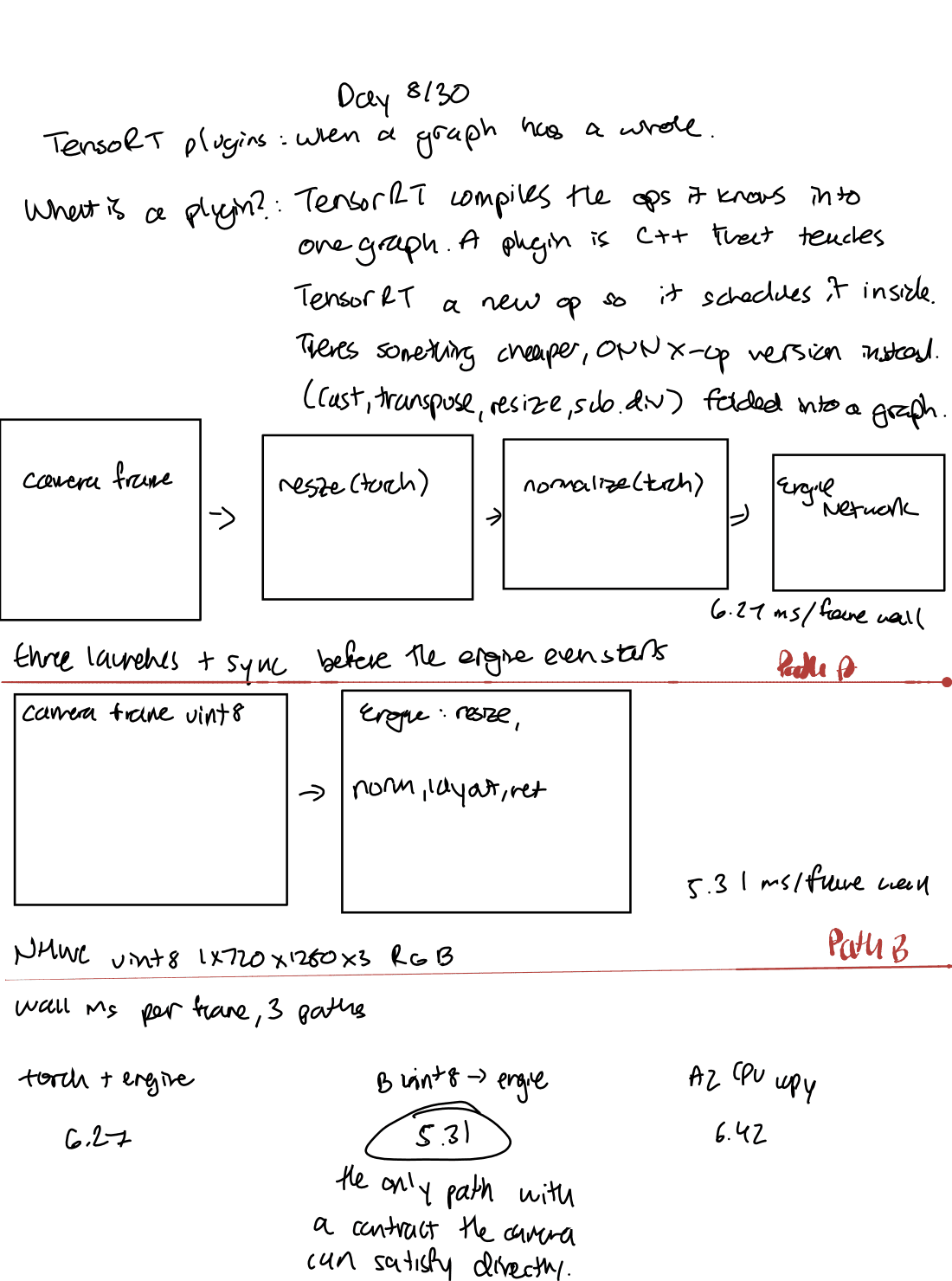
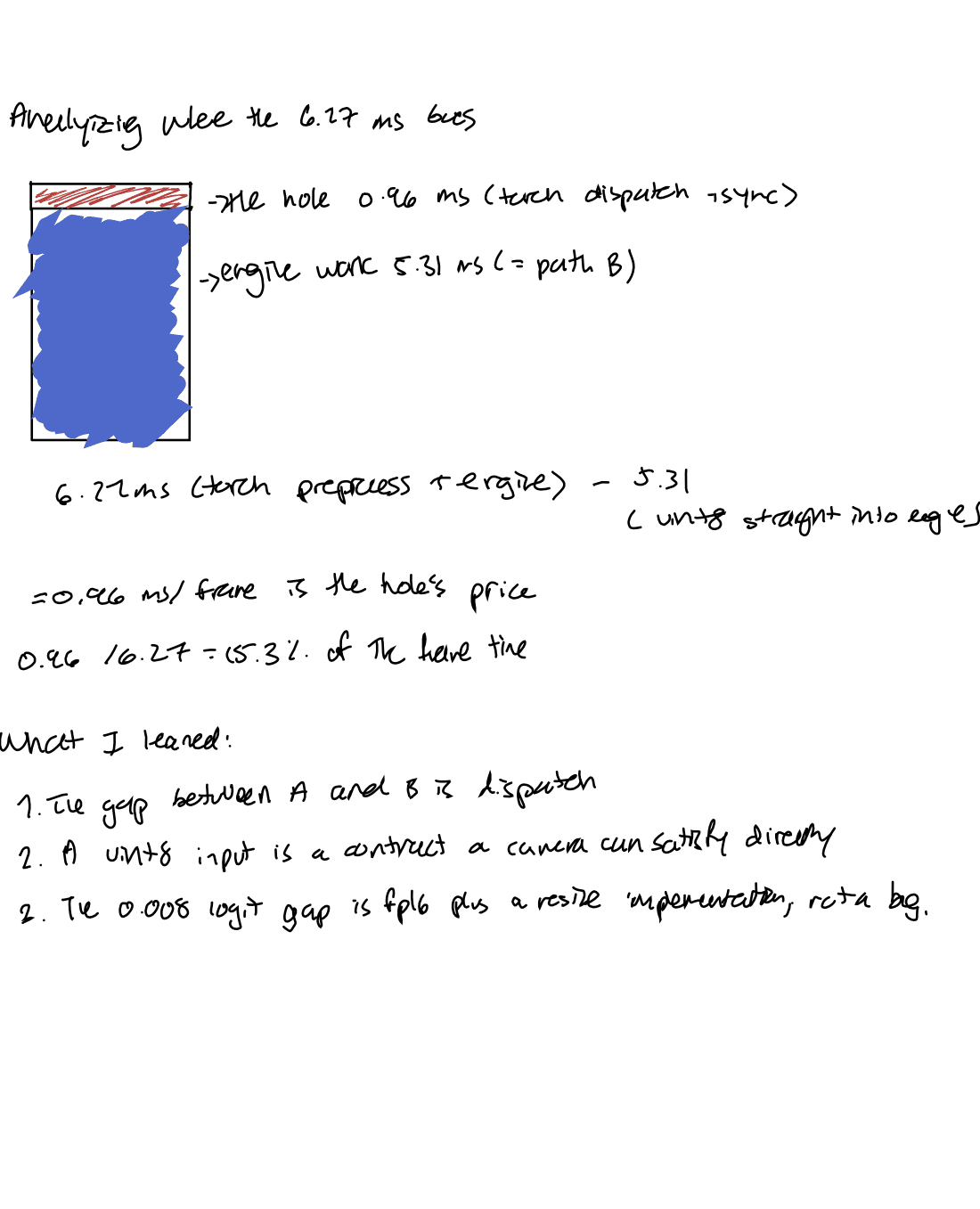
My notes from Day 8
Written by hand on 2026-09-08, before this chapter was typed. These are my original notes from that day. Where the chapter corrects them, the chapter is current.
Summary
- The gap between A and B is most likely bytes, not dispatch. The torch chain moves 50.7 MB for each frame. That is 0.75 ms at the roof and 1.55 to 1.6 ms at the bus speed Chapter 7 measured, more than the 0.96 ms gap.
- The engine that owns the camera tensor has a uint8 input. A camera driver can satisfy that contract directly. Only a Python script can satisfy the contract of a float NCHW tensor.
- The rule for a before/after comparison is the same input hash. The two paths ran the same frame ring. The logit difference is 0.0083, within fp16 rounding plus two resize implementations.
Sources
These sources are not mine. Measured numbers came off my own board; specs, estimates and paper figures are labeled as such.
- TensorRT Developer Guide: plugins, precision constraints, tactic selection
- TensorRT 10.3 release notes (the version on this board). Plugin ABIs change between versions.
- Board state captured 2026-09-29, not the state of the Day 8 run: L4T R36.4.2, CUDA 12.6, TensorRT 10.3.0.30, torch 2.8.0