The 8 GB Lab Book · Chapter 21
Choose the house SLM
- Board
- Jetson Orin Nano Super
- Mode
- 15W
- Summary
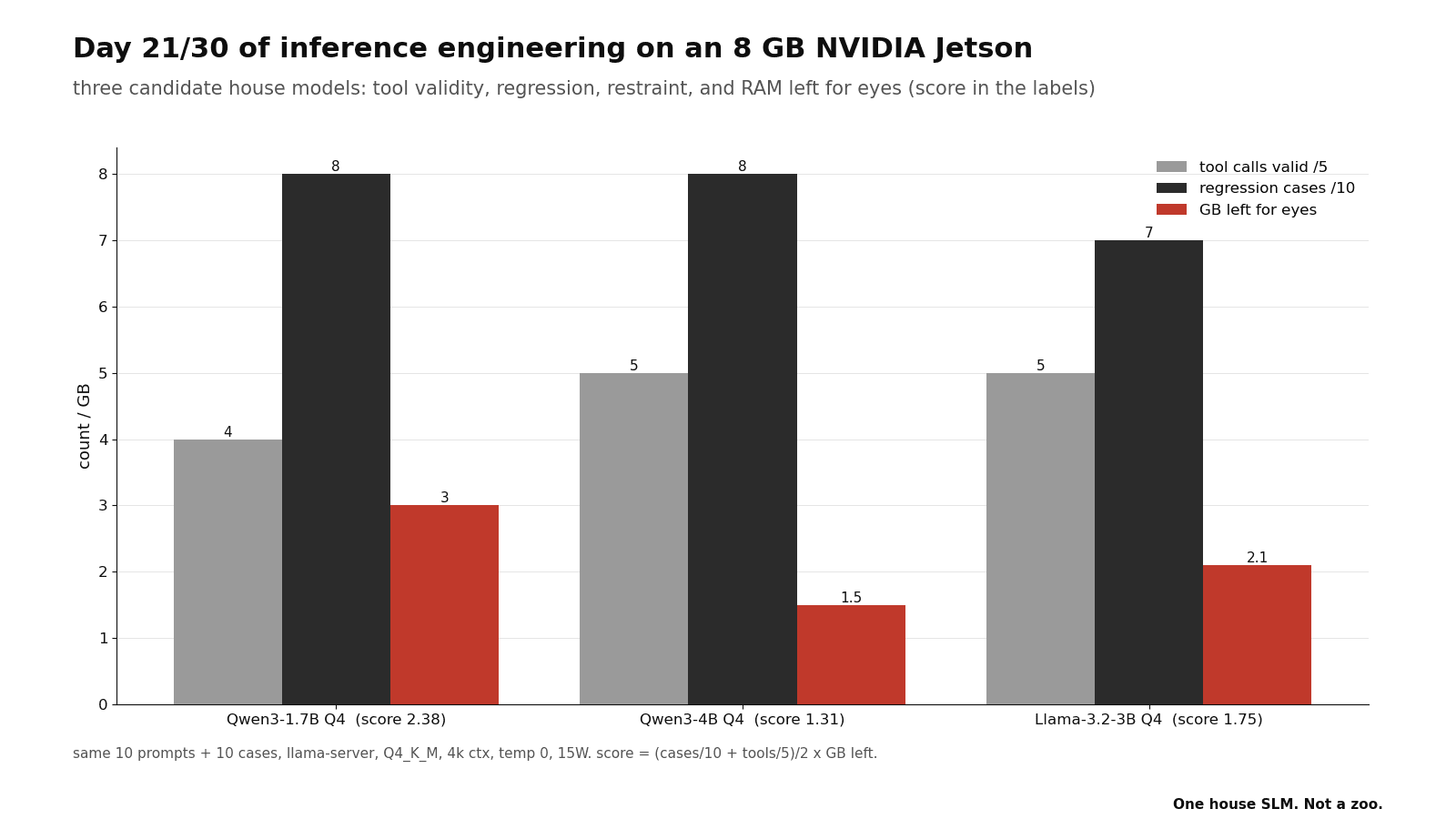
- Qwen3-4B Q4 is the house model: tools 5 of 5, restraint 2 of 2. My score picked the 1.7B, and a gate I wrote after the runs overruled it.
What I expected
Three models competed for one seat. I expected that the bigger Qwen would win by my own formula, with better tool calls and the same chat. I thought that the task half would separate the models. I thought that the RAM half would break ties between models that were almost equal.
I also expected that 5 of 5 would mean 'reliable'. Those expectations were about the design, not about the models. All of them were incorrect.
The theory
A product ranks by its widest factor; a gate is a step
RAM LEFT FOR EYES, Qwen3-4B (arithmetic, MiB counted as tegrastats counts them)
usable 7.62 GB (board, 7,620 MiB)
- 2.4 idle floor (that day's reading, not logged) - 0.7 runtime = 4.52
- 4k KV: 4096 x 144 KB (Day 3) = 576 MiB = 0.58
- weights, back-solved: 2.43 GB
check: 2.43 GB / 4 B = 4.9 bit per weight
= 1.5 GB for eyes; with Day 25's measured 1,498 MiB floor it is 2.4
The product, unrounded
1.7B: 0.80 x 2.975 = 2.38
4B:   0.90 x 1.456 = 1.31
3B:   0.85 x 2.059 = 1.75
task term spans 0.80 to 0.90: 1.13x
GB term spans 1.46 to 2.98: 2.04x
= a 2x factor outranks a 13 % factor
The printed GB column is rounded. The score divided by the task term gives the GB that the script really used: 2.98 / 1.46 / 2.06. A decodeThe phase after prefill where a language model generates one token at a time and re-reads its weights for each one; it is usually limited by memory bandwidth. check on the house model gives 2.43 GB x 10.7 tok/sTokens per second: how fast a language model reads a prompt (prefill) or writes output (decode); the two rates are different numbers. = 26 GB/s. This is the SLMSmall language model: a language model small enough, usually after quantization, to run on edge hardware instead of a data-center GPU. pull of Chapter 2 again.
If the true invalid rate were 10 %, five calls (theory)
- P(5 of 5 valid)
- 59 %
- P(4 of 5)
- 33 %
- what 5/5 proves
- rate < 45 %
The setup
bash ~/day21_23.sh
for t in qwen3-1.7b qwen3-4b llama3.2-3b; do python3 -c "import json;print('$t',json.load(open('$HOME/slm/$t.json'))['summary'])"; donepython3 -c "import json;[print(c['prompt'],'->',c['called'],c['pass']) for c in json.load(open('$HOME/slm/qwen3-4b.json'))['cases']]""tag": "qwen3-4b"
"model": "~/models/Qwen3-4B-Q4_K_M.gguf"
"ctx": 4096
"start_ms": 22139.825
"grammar": false
"chat": [ ... ]
"tool": [ ... ]
"cases": [ ... ]
"summary": { "ttft_ms_chat_median": 161.625, "decode_tps_chat_median": 10.699, "tool_valid": ...The measurement
| What | Expected | Measured | Note |
|---|---|---|---|
| Qwen3-1.7B Q4: tools/5 · cases/10 · restraint/2 | - | 4 · 8 · 2 | TTFT 101 ms, 22.8 tok/s |
| Qwen3-4B Q4: tools/5 · cases/10 · restraint/2 | - | 5 · 8 · 2 | TTFT 162 ms, 10.7 tok/s |
| Llama-3.2-3B Q4: tools/5 · cases/10 · restraint/2 | - | 5 · 7 · 0 | TTFT 119 ms, 13.5 tok/s |
| Qwen3-1.7B Q4: RAM left for eyes | - | 3.0 GB (estimate) | usable - floor - weights - 4k KV - 0.7 |
| Qwen3-4B Q4: RAM left for eyes | - | 1.5 GB (estimate) | usable - floor - weights - 4k KV - 0.7 |
| Llama-3.2-3B Q4: RAM left for eyes | - | 2.1 GB (estimate) | usable - floor - weights - 4k KV - 0.7 |
| score = task x GB left | - | 2.38 / 1.31 / 1.75 | the score picks the 1.7B; the 5/5 tool gate picks the 4B |
One stacked bar, bottom up, house model resident
- idle floor 2.4 GB, that day's reading; Day 25 logged 1,498 MiB
- runtime 0.7 GB
- weights Q4 2.43 GB
- KV at 4k 576 MiB
- eyes 1.5 GB left
| model | tools/5 | cases/10 | restr/2 | TTFT ms | tok/s | GB left | score |
|---|---|---|---|---|---|---|---|
| Qwen3-1.7B Q4 | 4 | 8 | 2 | 101 | 22.8 | 3.0 | 2.38 |
| Qwen3-4B Q4 | 5 | 8 | 2 | 162 | 10.7 | 1.5 | 1.31 |
| Llama-3.2-3B Q4 | 5 | 7 | 0 | 119 | 13.5 | 2.1 | 1.75 |
Where it broke
The formula ranked by RAM, because I let one factor change by 2x and the other factor by 13 %. I built a RAM contest and read it as a task score. It named the smallest model, as a RAM contest does. I added the gate afterward. The gate saved the decision, but it did not save the design.
The gate is five samples. 5 of 5 and 4 of 5 are one call apart, which is inside the noise of the coin above.
The biggest term of the score rests on a floor I read once and did not log. Chapter 25 measured the floor at 1,498 MiB vs MBA mebibyte (MiB) is 2^20 bytes and a megabyte (MB) is 10^6 bytes; some tools label MiB as "MB", so check which one a tool actually counts., 0.9 GB under the 2.4 I used here. With that floor the eyes slab of the 4B is 2.4 GB, not 1.5. The ranking does not move, but the room for a camera does.
Summary
- The tool-call column separates the models more than the chat column. All three models can talk. Fewer models emit a tool call when a user asks for one and stay quiet when nothing was asked.
- The RAM left for eyes is not a tie-breaker. It is half the score. Chapter 19 used it for vision tokens, and Chapter 25 uses it for voice. The house model must leave this RAM free.
- Qwen3-4B Q4 is the house model for Days 22 to 25. Each chapter in that range uses it.
- Write the gates before the score. Tool call emitted 5/5 and restraint 2/2 are pass/fail. They are not points. I learned this when I saw the score select the incorrect model.
Sources
These sources are not mine. Measured numbers came off my own board; specs, estimates and paper figures are labeled as such.
- Jetson AI Lab Gemma 4-on-Jetson page (Nano → E2B)
- Edge-LLM Nano bench table (Qwen3-0.6B/1.7B INT4)
- Jetson AI Lab SLM tutorial list